

We're Paris Antoinette, and we guide families and school groups around the Île de la Cité every week. Notre-Dame reopened in December 2024 after the fire of 2019, and its interior is brighter than it has been in centuries. Read on to make the most of your visit.
Before You Go: 5 Tips for Notre-Dame with Kids
- Going inside is free. Book a free time slot on the official website to skip most of the line. Slots open only shortly before (two days at most, sometimes just hours), so check the day before. Without one, expect to wait, especially in the afternoon.
- Come early or late. The cathedral opens at 7:50 a.m. on weekdays and 8:15 a.m. on weekends, and closes at 7 p.m. (7:30 p.m. on weekends, 10 p.m. on Thursdays). Check the official website before you go.
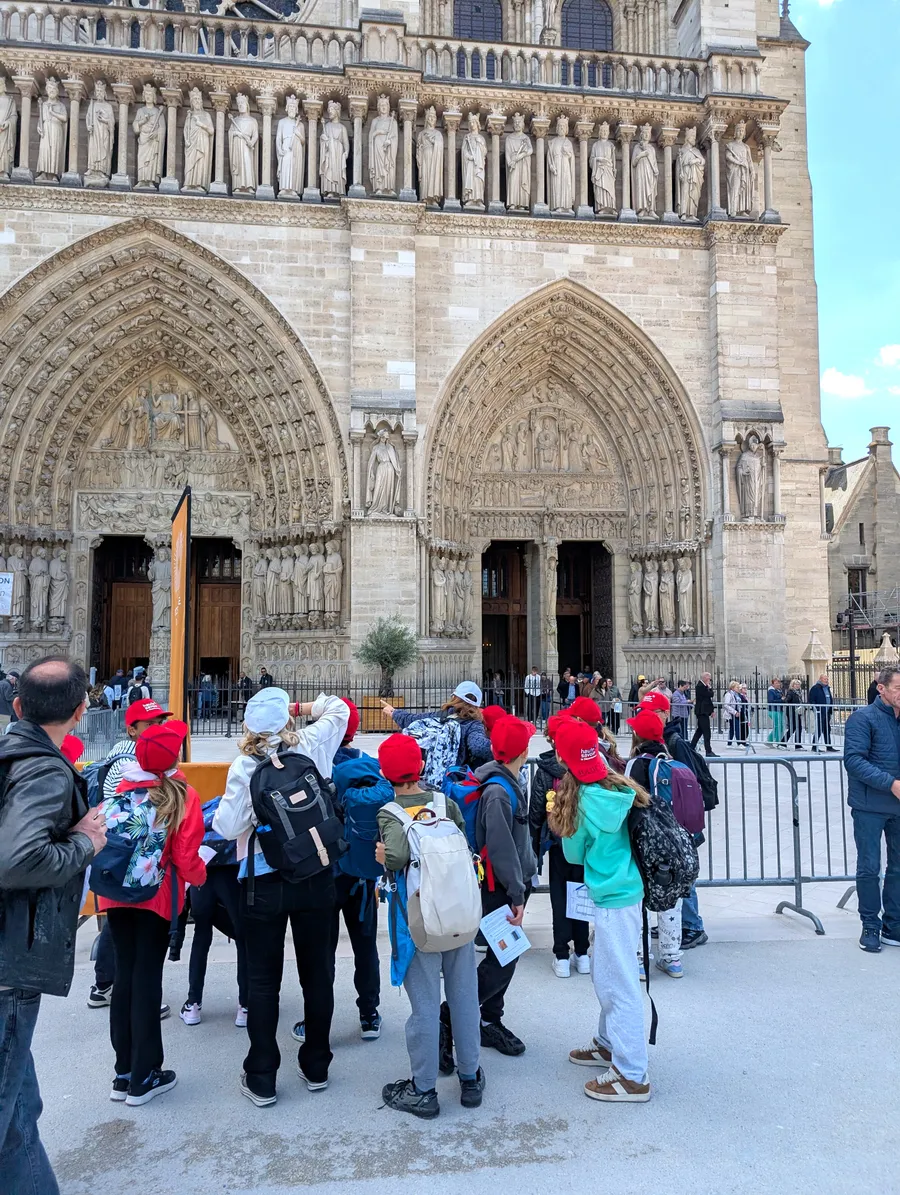
- Look up, outside. The best stories of Notre-Dame are carved on its façade, and kids can enjoy them without waiting in line.
- An easy, flat walk. Once you're above ground (the Cité metro station is deep, with lots of stairs), the route below is about a mile (1.5 km), flat, and easy with a stroller.
- Our tours stay outside. We explore the island and the façade with you. You can visit the inside of Notre-Dame on your own, before or after.
Where Paris Began
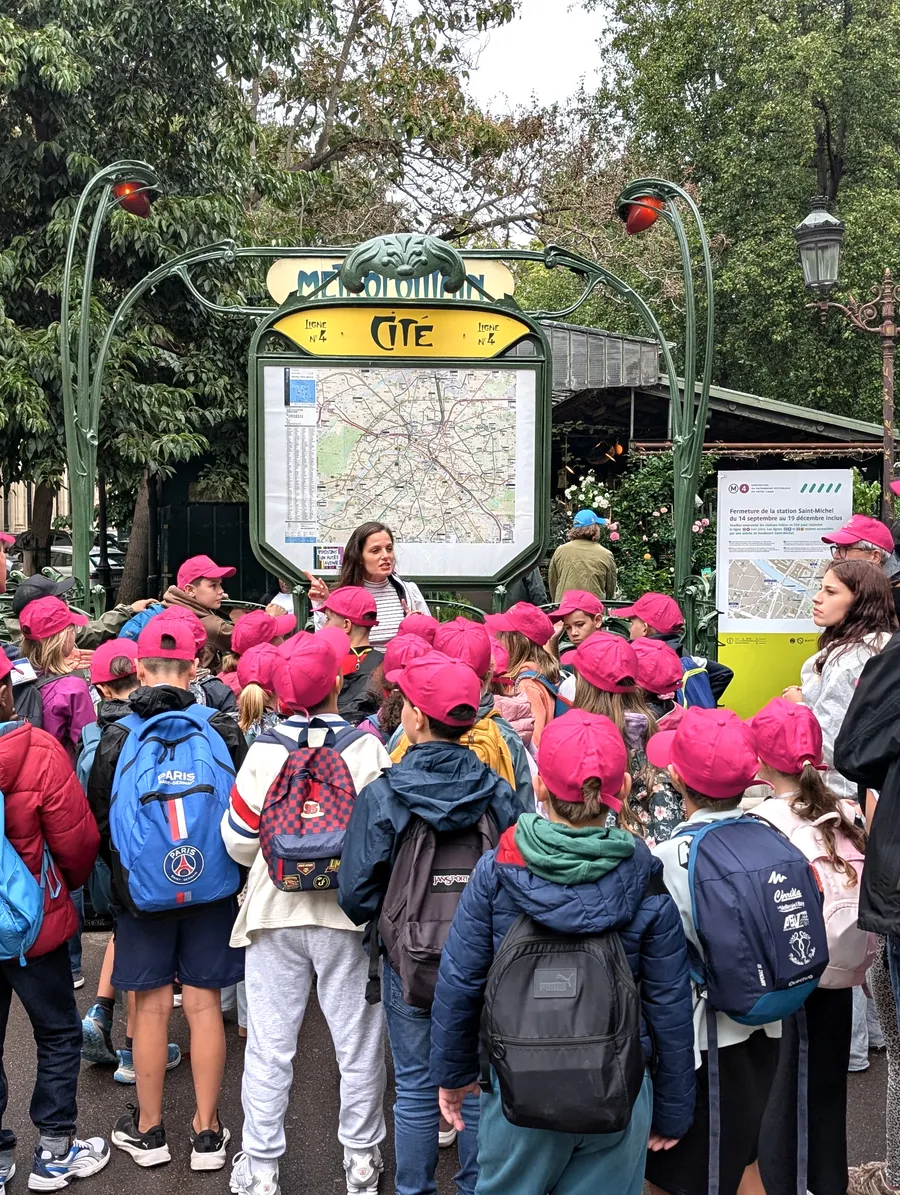
1. The Cité Metro Entrance
The Parisii, the Gallic tribe who gave Paris its name, lived along this part of the Seine. The Roman town of Lutetia grew on the island and the Left Bank. Today, you arrive through an Art Nouveau metro entrance by Hector Guimard, with green iron stems and a sign that seems to grow out of the plants.
Kid challenge: look at the green ironwork. Can you find something that looks like a flower bud or a lily?
2. The Palais de Justice and the Sainte-Chapelle
Behind the golden gate stands the Palais de Justice, still home to France's highest court, on the site of the palace where the kings of France lived in the Middle Ages. Hidden inside its walls is the Sainte-Chapelle, built by King Louis IX in the 1240s to hold the Crown of Thorns. Its upper chapel is walled almost entirely in stained glass.
Kid challenge: from outside, find the slender spire of the Sainte-Chapelle. Then guess: why would a king build a church inside his palace?
The Sainte-Chapelle needs a separate ticket. Book ahead. It's small and gets crowded.
The Conciergerie: Towers and Dark Stories
3. The Clock Tower
On the corner of the old royal palace, the Clock Tower holds Paris's first public clock, installed in 1370. Its blue-and-gold clock face, framed by statues of Law and Justice, still keeps time today.
Kid challenge: find the two statues beside the clock. What are they holding?
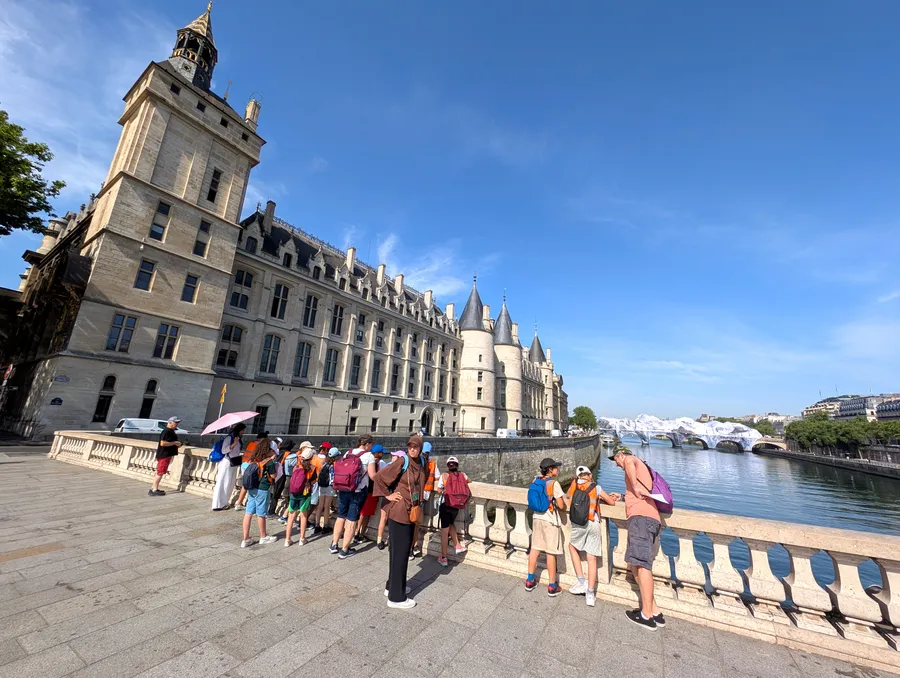
4. The Conciergerie
Seen from across the river, the Conciergerie looks like a fairy-tale castle, with pointed towers. Its story is darker. Part of the old royal palace, it became a prison, and during the French Revolution it held thousands of prisoners waiting for their trial. The most famous was Queen Marie Antoinette, in 1793.
Kid challenge: count the round towers along the river (there are three, plus the square Clock Tower). Then draw them in a notebook. Our young visitors love this one.
The Conciergerie's darkest stories are a highlight of our Notre-Dame and the Île de la Cité tour.
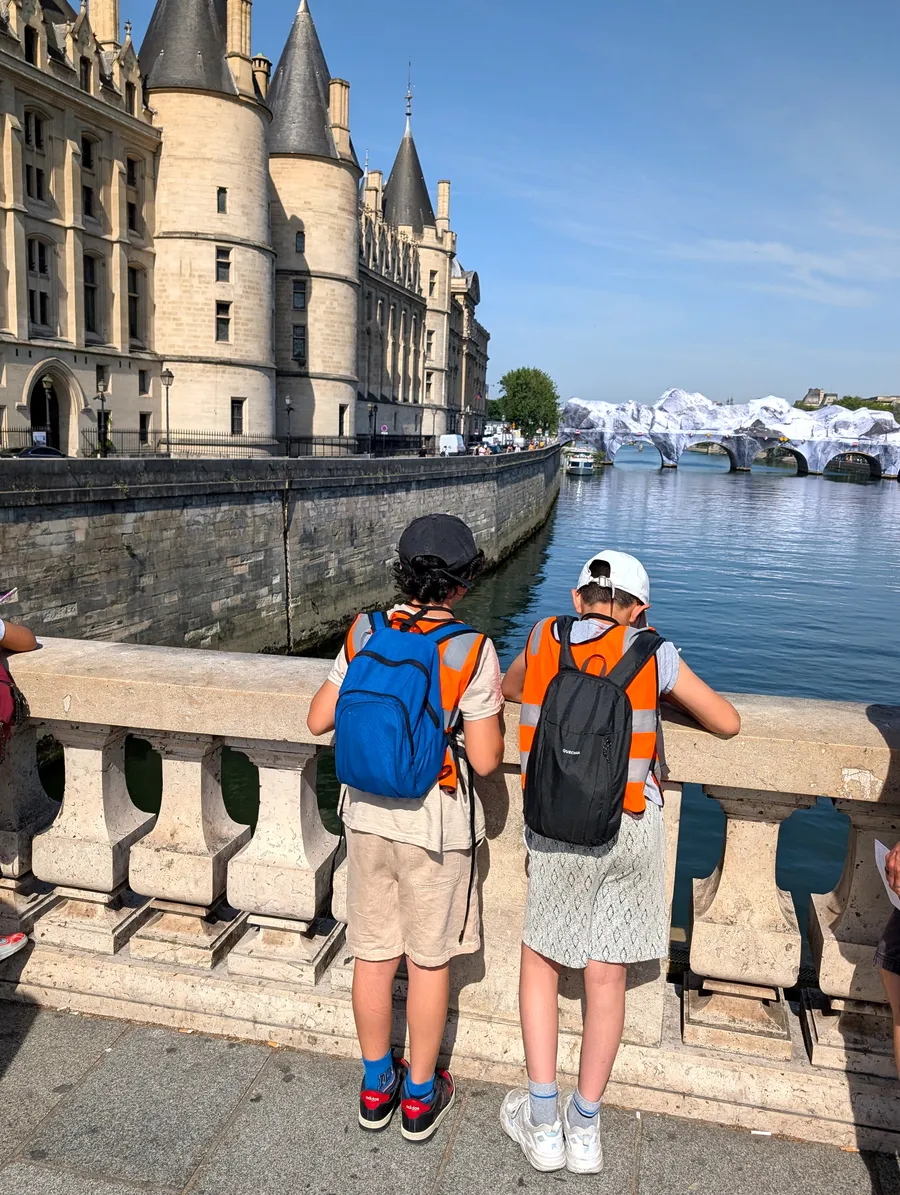
5. The Pont Neuf
Its name means "New Bridge," but it's the oldest bridge still standing in Paris, finished in 1607. It was the first bridge in Paris built without houses on it, and one of the first with sidewalks, so people could stop and enjoy the view of the river. In the middle, King Henri IV rides his bronze horse.
Kid challenge: from the quay beside the bridge, look at the faces carved under its edge. Some are smiling, some are grumpy. Which one looks the funniest?
Notre-Dame: Stories in Stone
6. Point Zero
On the square in front of the cathedral, look down: a small bronze star set in the ground marks Point Zero, the spot from which road distances from Paris are measured across France.
Kid challenge: find the star before your parents do. Legend says that if you stand on it, you'll come back to Paris one day.
7. The Façade and Its Bright New Look
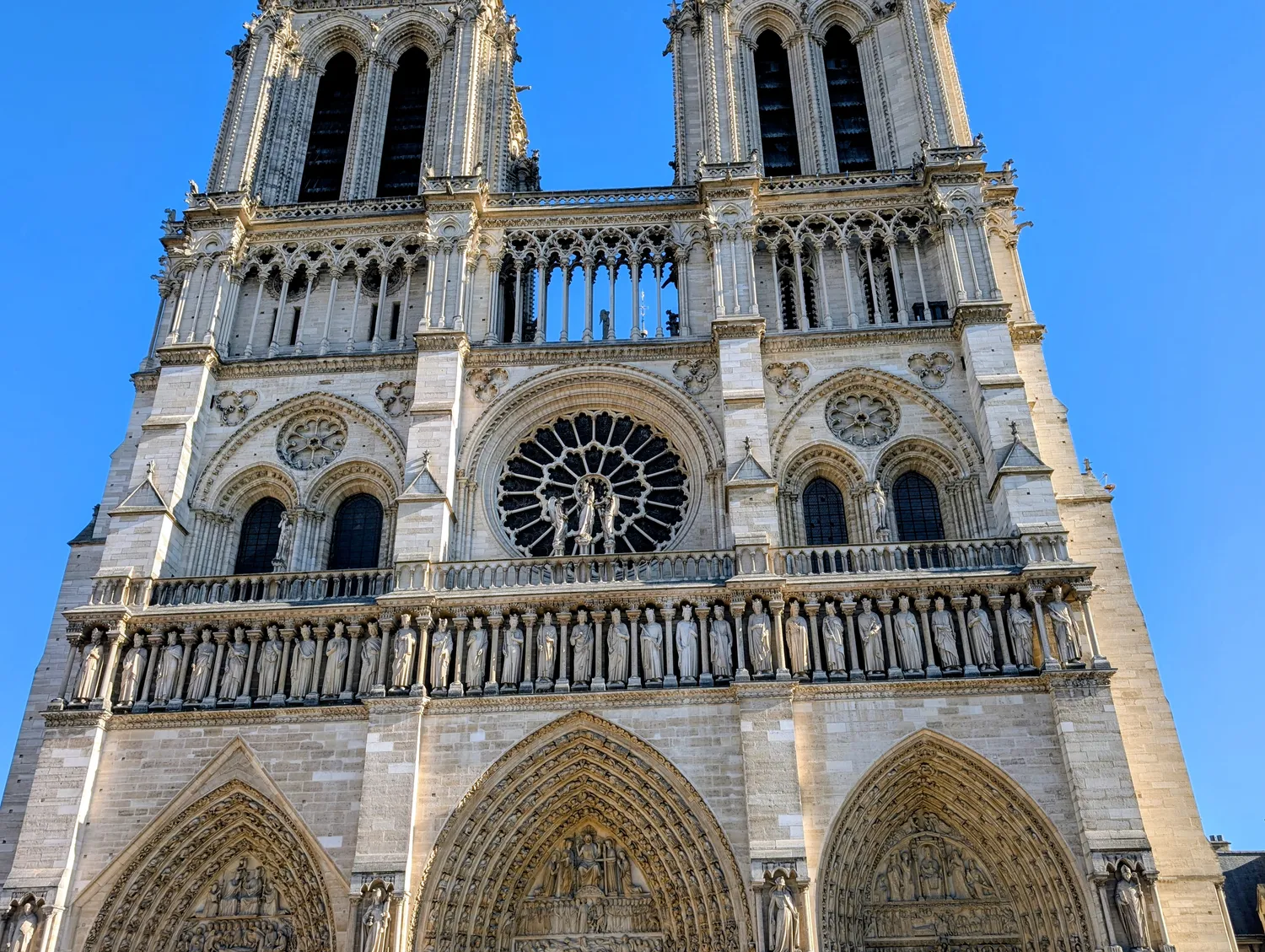
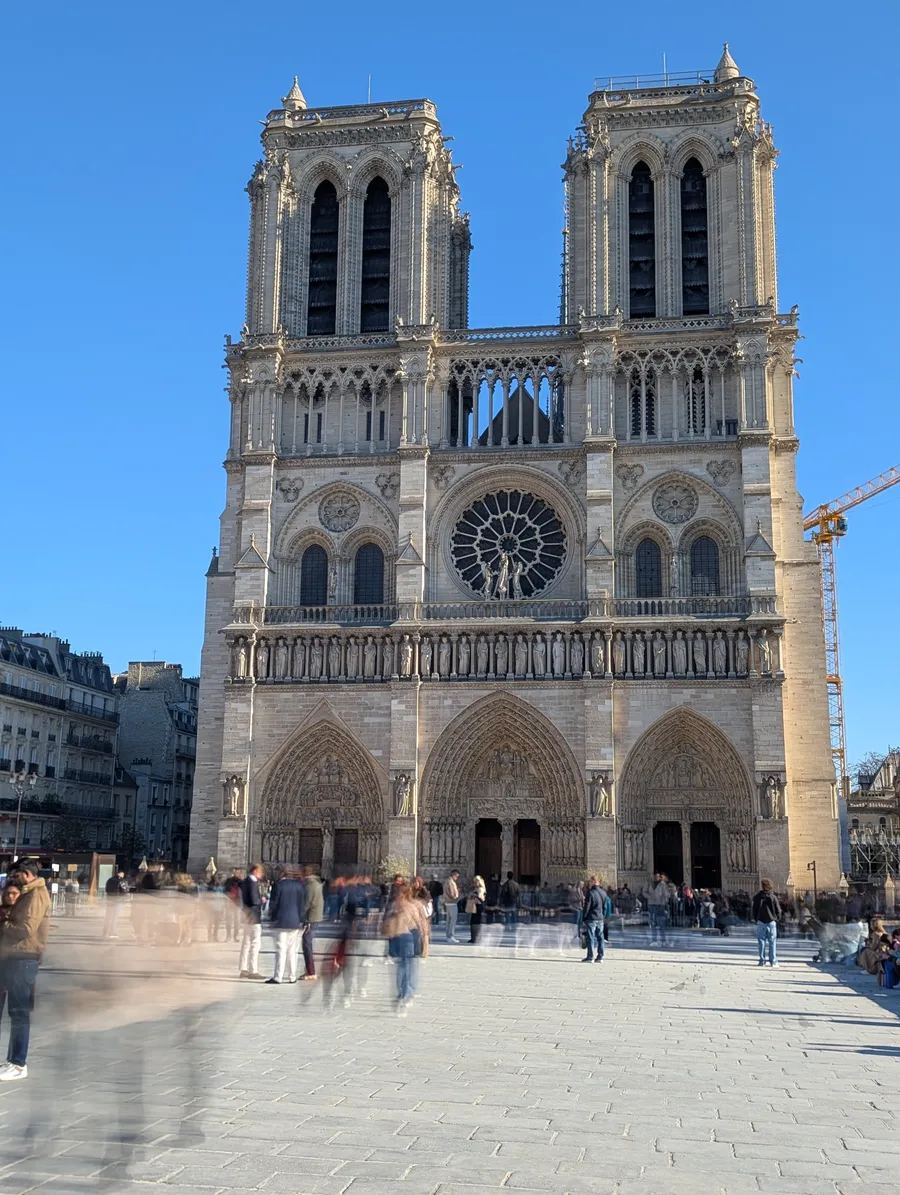
Construction began in 1163 and took nearly two centuries. After the fire of April 15, 2019, it took more than five years of work to repair the roof and rebuild the spire. The cathedral reopened in December 2024, with its interior stone cleaned to a pale, creamy glow.
Kid challenge: count the doors on the façade. Then look at the two towers: are they exactly the same?
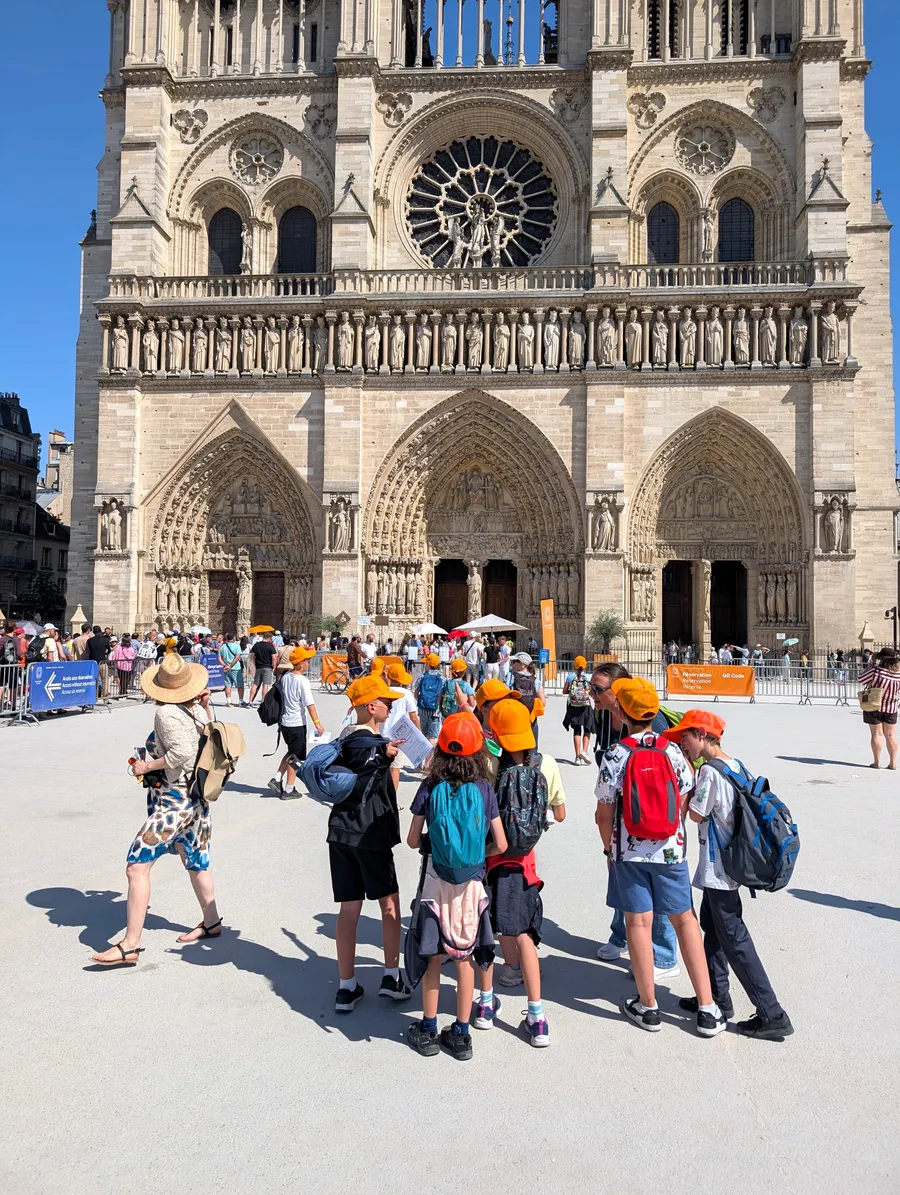
8. The Gallery of Kings
Above the doors, a row of 28 statues stretches across the façade. They're the kings of Judah, from the Bible. During the French Revolution, people thought they were kings of France and cut off their heads. The statues you see today are 19th-century copies. In 1977, 21 of the original heads were found buried in Paris, and they're now displayed at the Musée de Cluny.
Kid challenge: count the kings. Do you get 28? Imagine how surprised the workers were when they dug up the heads in 1977.
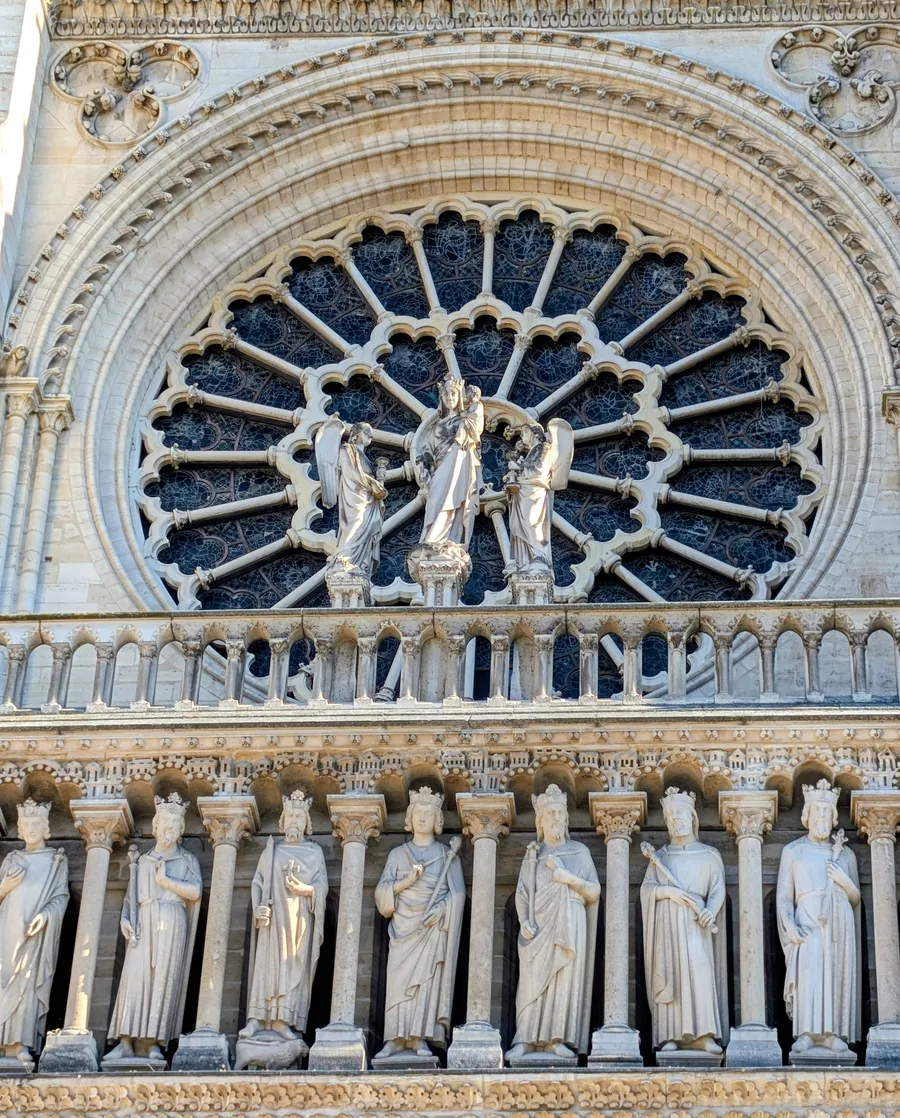
9. The Rose Window
Above the kings, the great round rose window is about 31 feet (nearly 10 meters) across. In front of it, the Virgin Mary holds the baby Jesus, between two angels.
Kid challenge: the rose window looks like a giant flower, or a wheel. What does it look like to you?
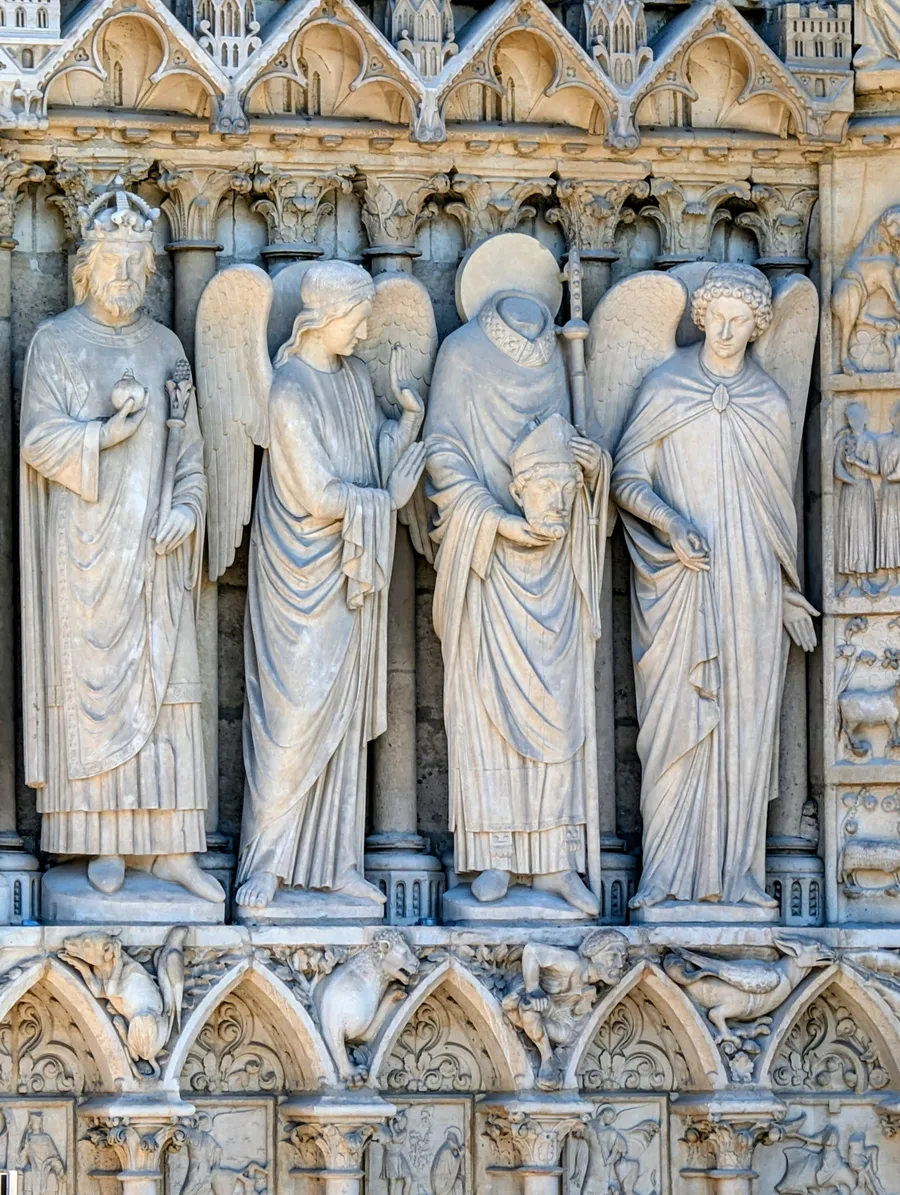
10. Saint Denis Carrying His Head
On the left door, the Portal of the Virgin, look among the tall statues. One of them is holding his own head in his hands. It's Saint Denis, the first bishop of Paris. Legend says that after he was beheaded on the hill of Montmartre, he picked up his head and kept walking.
Kid challenge: find Saint Denis. Who is standing on each side of him? (Two angels.)
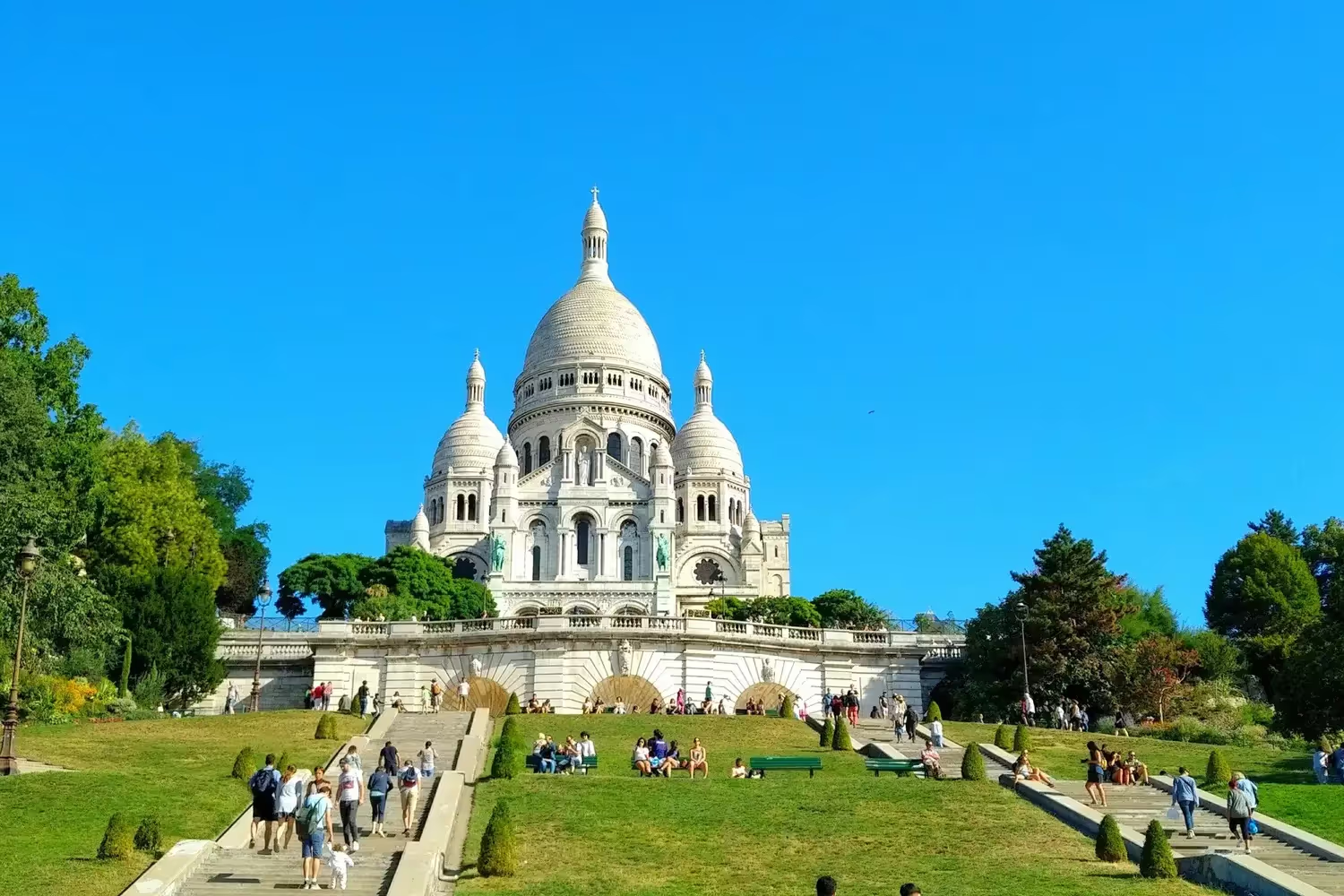
You can find Saint Denis again in our Montmartre with Kids guide.
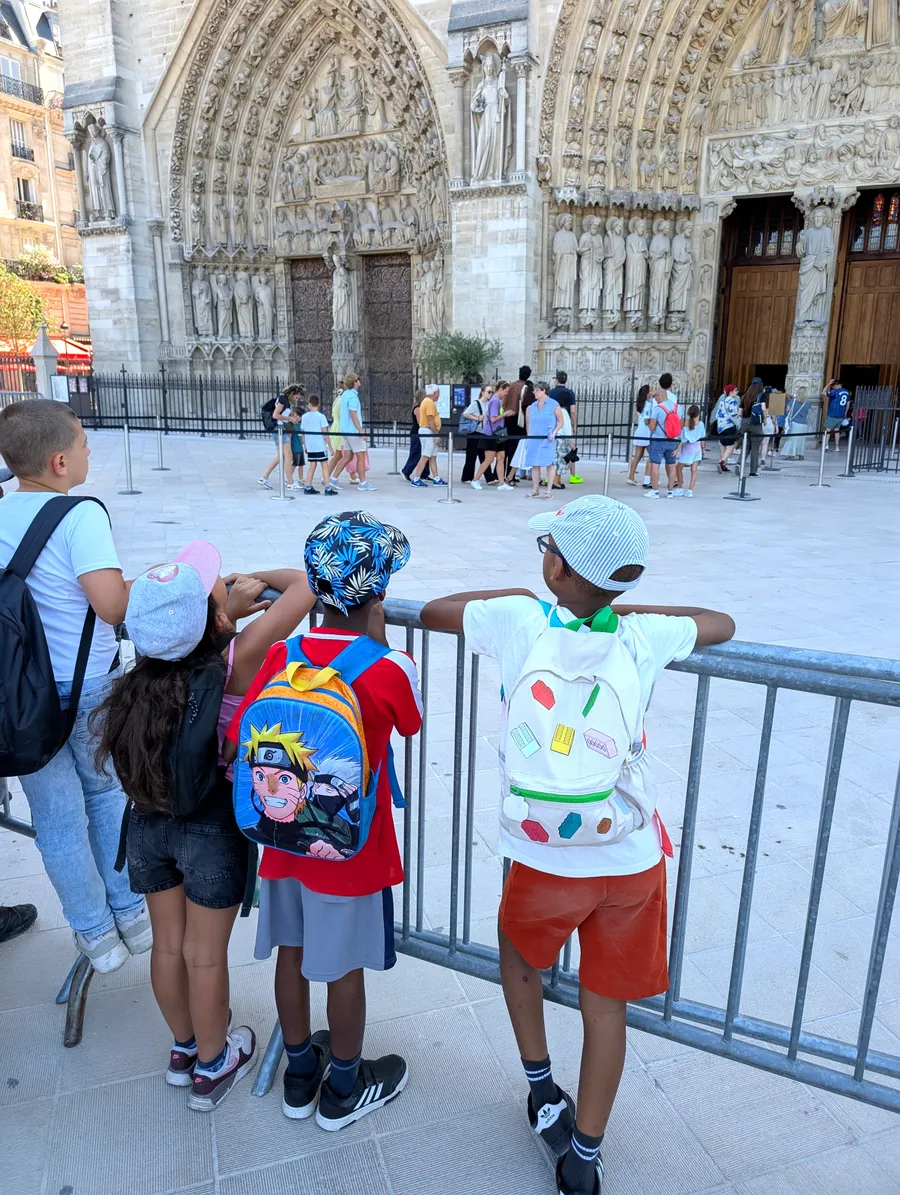
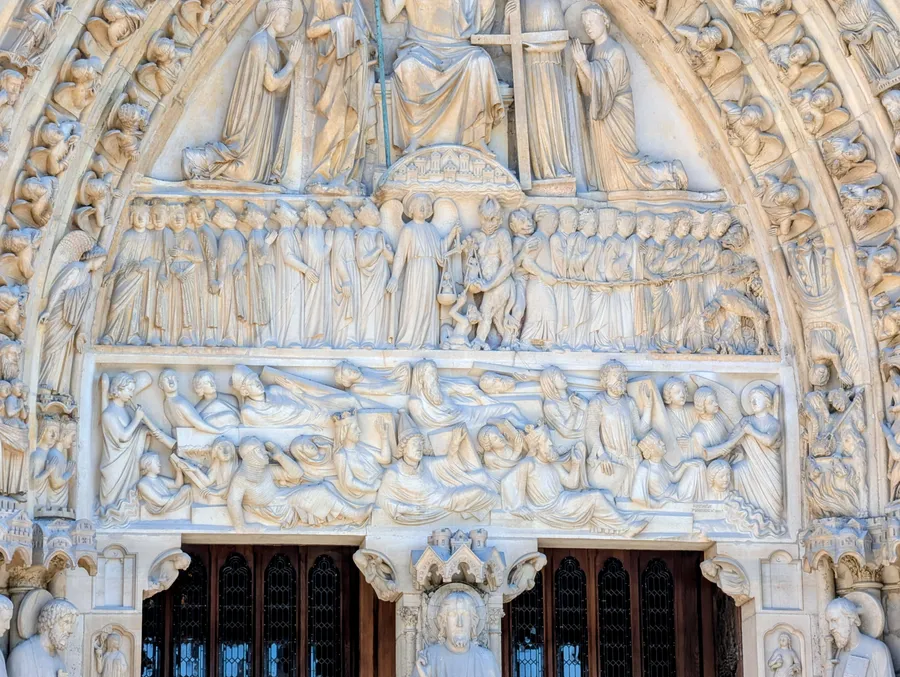
11. The Last Judgment Portal
The central door tells the story of the end of the world. On the lowest band, the dead rise from their tombs. Above them, Saint Michael weighs souls on the scales, and a little devil tries to cheat by pulling the scales his way.
Kid challenge: find the devil cheating at the scales. Then look: who heads up to heaven, and who gets dragged off by devils?
12. Gargoyles and Chimeras
High up on the towers, stone monsters look down on Paris. The gargoyles are actually rain gutters. When it rains, water pours out of their mouths. The chimeras are just for show. Architect Viollet-le-Duc added them in the 1800s. The most famous, the Stryge, rests its chin in its hands.
Kid challenge: look up and find a monster. Is it a gargoyle (with an open mouth to spit water) or a chimera?
Fun fact: in 1831, Victor Hugo published The Hunchback of Notre-Dame. The novel was so popular that it helped convince France to restore the cathedral, which had been badly neglected.
Want an Expert to Bring It All to Life?
On our private Notre-Dame and the Île de la Cité tour, kids search the façades for hidden details, hear the darkest stories of the Conciergerie, and imagine life on the island in the age of kings. It's an outdoor walking tour, so you can visit the inside of Notre-Dame on your own, before or after. Tours last 90 to 105 minutes, they're in English, and they're just for your family. Best for ages 6 to 11.
Starting at €420 for a private group of up to 10 people.
Heading to the Louvre next? It's a short walk along the river. Read our Louvre with Kids guide.